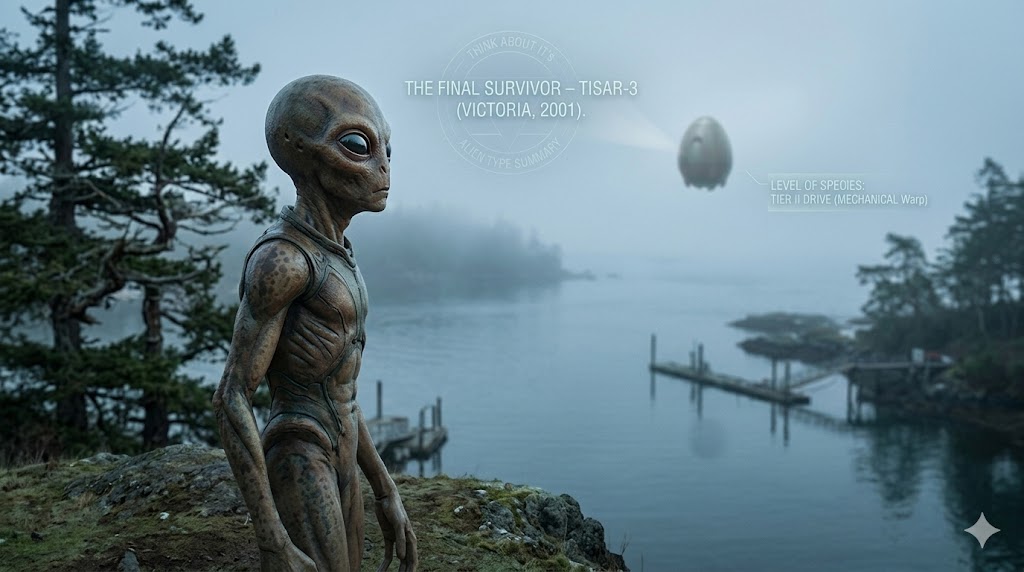
THE FINAL SURVIVOR. A Tisar-3 entity monitors the Victoria harbor. This image visualizes the ultimate isolation of a meta-terrestrial group that has outlived its own history.
THINK ABOUTIT’S ALIEN TYPE SUMMARY – TISAR – 3
The Tisar-3 represent a tragic anomaly in the Think About It Alien Database. Classified as survivors of an extinct Reptoid lineage, they occupy a unique position as meta-terrestrial refugees. Lacking the high-level technological advancements or vast cosmic knowledge possessed by groups like the Pleiadians or the Greys, the Tisar-3 are often characterized by their struggle for survival within a galaxy that has largely moved past their era.
Name: TISAR – 3
AKA: The Reptoid Survivors, The Siena Entities
Location – Home System: Unknown (Reports suggest a 2-Earth-year transit time to reach our sector).
Distance from Earth: Variable (Deep Space nomadic status).
Attitude: Desperate, cautious, and elusive.
Motives: Survival, sanctuary, and avoidance of further extinction-level events.
Physical Appearance: Humanoid-Reptoid hybrid characteristics; skin texture mimics human qualities but retains reptilian durability.
- Average Height: 5.5 – 6 Feet
- Average Weight: 140 – 160 lbs
- Body Temperature: Fluctuating (Ectothermic-Humanoid bridge).
- Pulse/Respiration: Slower than human baseline; optimized for long-duration transit.
- Blood Pressure: High-viscosity circulatory system.
- Life Expectancy: Diminishing (Due to genetic degradation of an extinct line).
- Hair: None
- Skin: Mottled, resilient, and human-like in tactile quality but reptilian in appearance.
- Eyes: Large, observant, and sensitive to low-light environments.
- Sex: Binary (Dimorphic).
Other Physical Information: Possess a mix of reptilian resilience and human-like vulnerability.
Special Traits and Abilities: High-level endurance; adaptive camouflaging of energy signatures.
Communication Type: Low-frequency telepathy; often described as “heavy” or “labored” mental projections.
Origin: Extinct Reptoid System (Nomadic refugees).
Life Form Type: Reptoid-Humanoid hybrid.
Subspecies: None (Final remnants of their lineage).
Most Common Species: Tisar-3 (Singular Group).
Level of Species: . Technical Tier II (Lower than standard visiting groups).
Habits: Seeking isolated landings, church/ruin-based scouting, and remaining in deep concealment.
Transportation Type: Low-tech craft; reliance on older-generation propulsion systems.
Witnesses Reports: Siena, Italy (1977/78), Victoria, Canada (2001), USSR APIS/3 Records.
Special Features/Characteristics: Survivors of an extinct race; lack of parity in interstellar tech-capabilities.
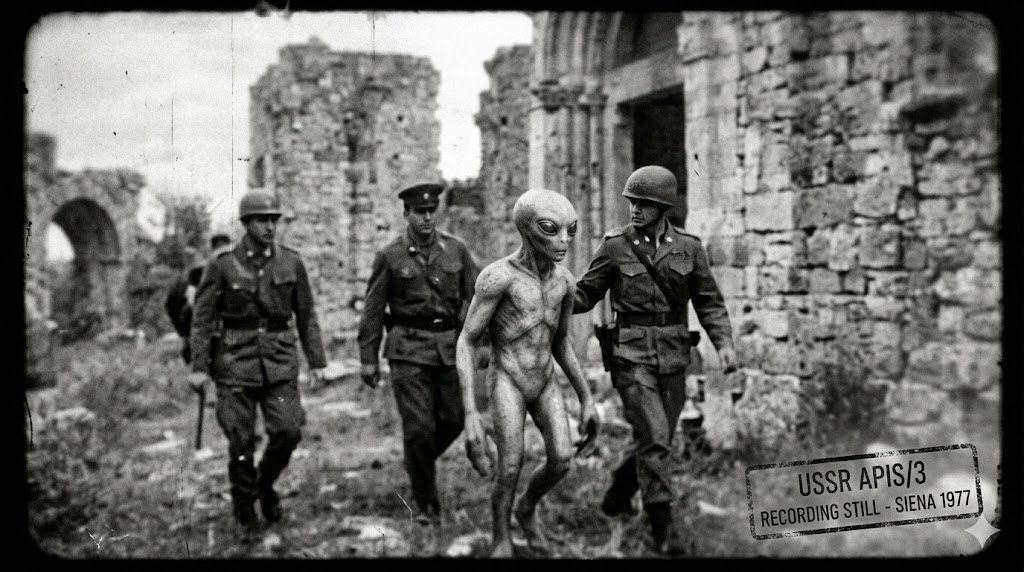
Summary/Description: In 1977 or 1978 , near Siena (Italy) ,2 of their species were captured after landing behind a church on ruins…3 day later they were transferred to a USA air base still in Italy and finally taken to an undisclosed location where, supposedly , they still remain… contacts have mentioned somewhere in the South Pacific or in another USA base near Japan. The USSR APIS/3 was able to get a hold of 1 video recording of this species. Last sighting :January 3 2001 , near Victoria , Canada.” A nomadic remnant race seeking refuge; often captured or detained due to inferior defensive technology.
Source: USSR APIS/3, Riley Martin, local Italian military archives.
THE REPTILIAN REMNANTS
![Technical schematic composite for [Think About It Alien Database] detailing Tisar-3 (Siena, 1977) physiology, featuring the last survivor, Siena Incident film still, and a technological disparity drive comparison.](https://thinkaboutit-aliens.com/wp-content/uploads/2025/09/unnamed-2026-03-04T090433.801.jpg)
The Siena Incident: A Study in Capture
The most heavily documented interaction with the Tisar-3 occurred in late 1977 or early 1978 near Siena, Italy. This encounter is crucial because it highlights the fundamental technological vulnerability that defines this group. Witnesses reported two individuals were captured after their craft landed in the specific ruins located behind a local church. While most meta-terrestrials can depart instantly upon detection, the Tisar-3 craft appeared to suffer from mechanical latency or perhaps fuel depletion—a common issue for Tier II legacy technology.
The entities were detained locally before being transferred, three days later, to a United States air base still located in Italy. Their final destination remains undisclosed, but intelligence reports obtained by the Think About It Alien Database suggest they were moved to a South Pacific facility, or potentially another joint US-Japanese base near Okinawa. These individuals were described as appearing physically and mentally exhausted—a rare observation for meta-terrestrials, but consistent with a species that has been nomadic for generations.
Technological Disparity and the Extinction Gap
One of the most defining characteristics of the Tisar-3 is their lack of technological parity. This is a point of confusion for many researchers who assume all non-human visitors possess near-magical capabilities. The Tisar-3, however, appear bound by archaic interstellar laws that other groups have long since mastered. Reports indicating a standard transit time of two Earth years to reach the Sol system confirm a dependency on slower-than-light or early-generation mechanical warp propulsion.
This technological gap makes them vulnerable to human military interception—a situation that would be nearly impossible for groups like the Santari. They cannot interdimensionally “jump,” nor can they phase-shift their craft to become intangible. Instead, they rely on basic mechanical durability and the desperate hope of remaining unseen. This makes them, despite their reptilian form, perhaps the most vulnerable and relatable non-human group currently monitoring Earth. They are the “Lost Tribe” of the stars, traversing the cosmos in vessels that are effectively flying antiques.
The APIS/3 Evidence and Soviet Monitoring
The presence of the Tisar-3 did not go unnoticed by global monitoring organizations. The specialized USSR APIS/3 project (the Soviet counterpart to American MILAB monitoring) was reportedly able to acquire a singular video recording of this species. This footage, believed to be the only existing visual record of a Tisar-3, shows a being that appears “spiritually depleted.” The APIS/3 analysis describes entities that seem fundamentally fragile, contrasting sharply with the robust strength often associated with aggressive reptilian lines.
This data suggests that the Tisar-3 are not genetic aggressors. Instead, they appear to be suffering from a catastrophic form of long-term inbreeding or genetic degradation—the inevitable consequence of being the final survivors of an extinct bloodline. They are not here to harvest human DNA for an army; they are likely seeking genetic revitalization for a dwindling population. They are the record-keepers of a doomed history, hoping that Earth might provide a sanctuary before their last flame is extinguished.
The Last Sighting and the Nomadic Mandate
The most recent credible sighting of a Tisar-3 occurred on January 3, 2001, near Victoria, Canada. This event is critical because it confirms that despite their extreme vulnerability and technical limitations, a small pocket of these survivors remains active and nomadic. While most visiting groups utilize large crystalline mother ships, the Tisar-3 utilize isolated coastal regions, like British Columbia, as staging grounds for basic resource gathering.
Their focus on remote coastal areas, rather than high-surveillance urban centers, is a necessary survival adaptation. Following the 1977 capture, the Tisar-3 adopted a “Nomadic Mandate” of total deep concealment. They operate with extremely low energy signatures and avoid all communication. For humanity, the Tisar-3 serve as a sobering reminder that extinction is a universal possibility. They are not gods; they are cosmic vagabonds, demonstrating that in the vastness of the cosmos, survival is often the greatest achievement of all.
FINAL SUMMARY: SOVEREIGN VERDICTS
The Tisar-3 represent a tragedy written in the stars. To encounter them is to witness the final breath of an ancient Reptoid lineage. They are neither predators nor teachers; they are survivors. Their “human-like” skin and desperate motives create a rare sense of cosmic empathy. While they lack the technology of their peers, their endurance is unparalleled. They remind us that the universe is not just filled with powerful beings, but also with those simply trying to find a home before the lights go out. They are the silent witnesses of their own end, a final nomadic thread in the vast tapestry of life, hoping against all odds for a new beginning.